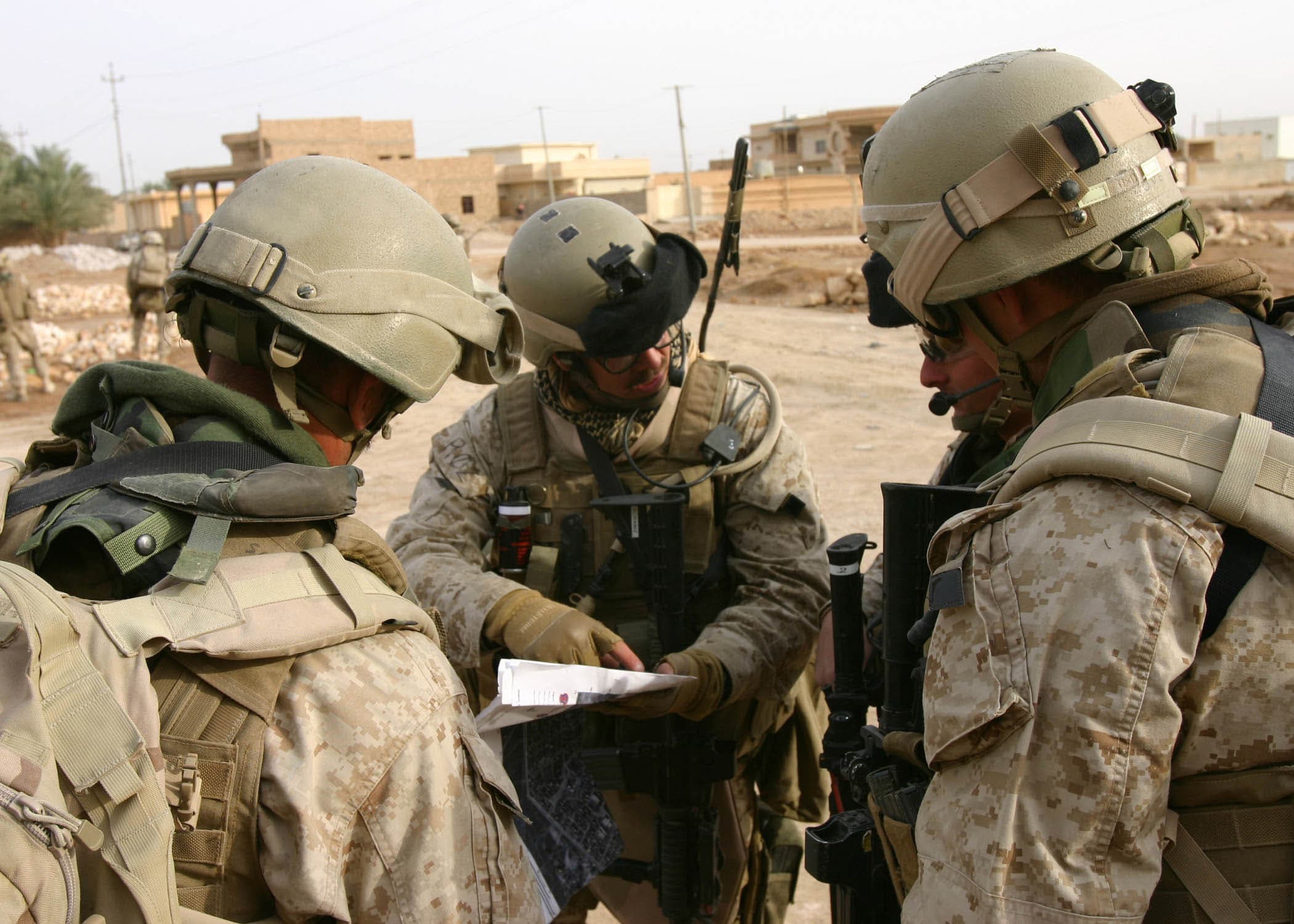
What Did You Actually Learn?
Free training, contract work, and making sure people can use what we teach.
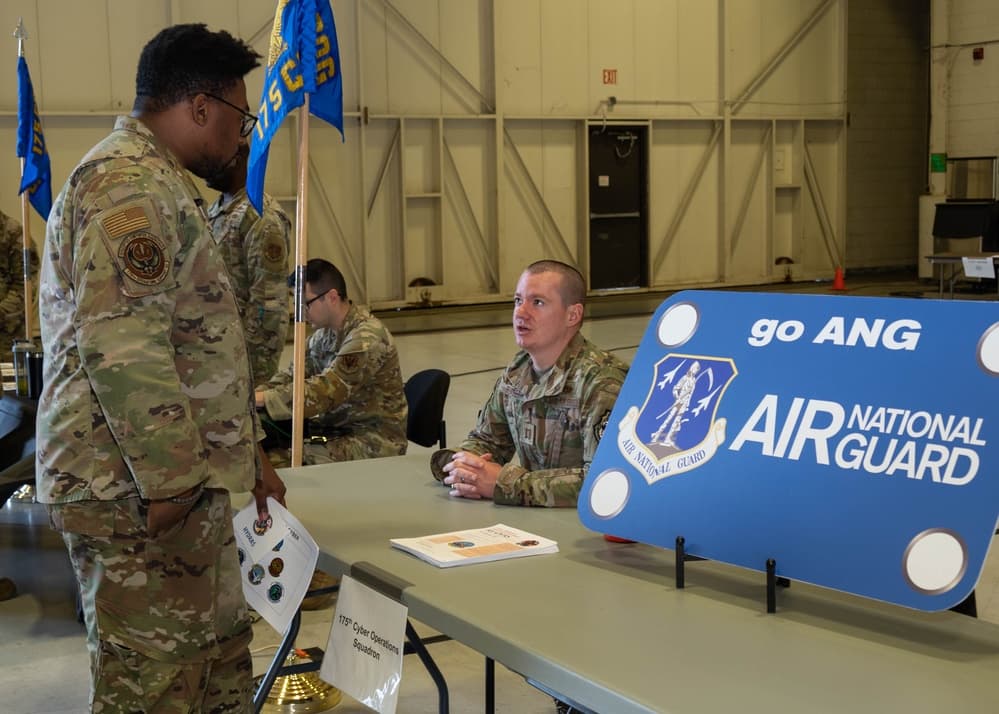
Airmen discuss career and cross-training opportunities at the 175th Wing Resource Fair in Middle River, Maryland, May 1, 2025. Illustrative file photo; not an EPS event. U.S. Air National Guard photo by Airman 1st Class Sarah Hoover. Source: DVIDS (public domain).
Training for the Next Job
A lot of people are having a hard time finding work, and a lot of the people I talk with don't realize how much training they can get without paying for it. At Resource Friday with Jobs Have Priority in D.C., I spent time with new students and caught up with some of my old ones, which is always a good time. I brought folders, little notebooks with our EPS stickers, and information about our AI course, the job portal, and free training available through us and other organizations. Most of what I do at these events is explain what opportunities are available and help people figure out where to start. I used to be a recruiter, and I still see some of the same situations: somebody looking for another employer after the last one didn't work out, somebody trying to find work in a crowded field, and the security contractor whose job depends on whether the company keeps the contract. The advice depends on the person and what they're trying to do, but the goal is to give them something useful to work with after they leave. People are grateful when somebody takes the time to help, and I want to keep doing as much of that as I can.
One of the articles I read this week was about Amentum, a government contractor planning to cut 77 jobs connected to intelligence work at Fort Gordon. WRDW/WAGT, a local television news outlet, reported the planned cuts on September 15. Amentum attributed them to contract transitions, and its advance layoff notice filed with Georgia lists October 31 as the expected date for the first layoffs. That includes positions for guards and alarm monitors. Companies win and lose contracts every day, and sometimes the positions go with the contract. That is the contracting business, and the intelligence label by itself doesn't tell me much more than that. If I were bidding on work in that area, I would be looking at it differently: did the work end, did the scope change, or is another company taking over? That would be useful information about the competition, but the article alone doesn't answer all of it. I wouldn't turn the name on the contract into a bigger story without knowing what actually happened. For the people affected, the immediate problem is finding the next job, whatever the headline calls the last one.
That is where I want our training and employment resources to help. The problem with some free training is that you finish with another piece of paper and very little you can explain to an employer. Make up something ridiculous, call it Advanced Stapler Appreciation, and put a nice border around it. I was a recruiter; I want to know what you learned and what you can do with it. Free training can be worth a great deal, but being free does not automatically make it worth your time, and charging for it doesn't settle that question either. I want our students to earn useful certifications and retain what we taught them, because if they leave without understanding the material, we have wasted their time. We have free courses available, and recruiter accounts and job posting are currently free, so people have access to training and somewhere to look for work. Security and contracting are where much of my experience comes from, but we want to help people get further in more than one field.
We also ran a Wear & Carry course for a church group, and that was a great time. They're a growing church doing good work, and I enjoyed having the opportunity to train with them. Between groups like theirs and the people we meet through Jobs Have Priority, there is plenty of work I would like to keep doing. I only have so much bandwidth, but I want to keep helping as many people as we can. God bless.
The Tool Belt
I couldn't keep up with half of what I do without AI, but I use it like a tool in a tool belt. I use OpenAI's tools, Claude, and Grok, and the task determines what I reach for. OpenAI has been the most versatile for me personally, but that doesn't mean I use one product for every part of a job. What matters to me is efficiency: finding a useful way to get something done that saves time. For example, we've used OpenAI's text-to-speech tools to make an audio version of course material. That gives students another way to access the material and saves time in the process. I still need to understand the work and check the result, and the training still depends on knowing the subject and teaching it well. I only have so many hours in a day, and with everything I'm juggling, that time matters.
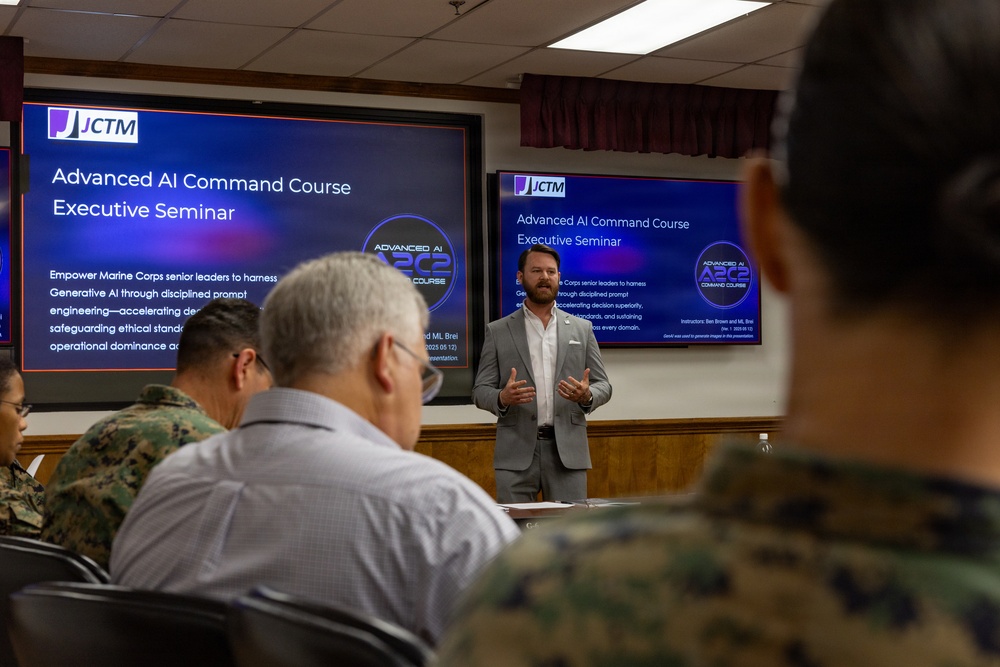
Ben Brown teaches the Advanced Artificial Intelligence Command Course at Camp Lejeune, North Carolina, December 12, 2025. Illustrative file photo; not an EPS course. U.S. Marine Corps photo by Lance Cpl. Payton Walley. Source: DVIDS (public domain).
I also hate AI slop: the generic posts, the generated pictures, the endless content that all starts to look and sound the same. There is so much trash out there, and a lot of it is ugly. That's one reason I take the time with these articles and my emails, reading them over and changing what doesn't say what I mean. Ask the people I work with: if I'm busy and passing along a quick AI response, I'll usually say something like, "Hey, I'm busy. I used AI, and I'm copying and pasting what it gave me. I'll get back to you soon." I'd rather be clear about that. It reminds me of memes when I was in high school: something that was funny gets copied into every unrelated Facebook post until you're looking at the same tired joke under a motivational quote. That's how a lot of this AI content feels to me. I use these tools for efficiency, but posting whatever they produce without putting any thought into it is a pet peeve of mine. I have no interest in filling somebody else's feed or inbox with more of that.
Where people get it wrong is treating AI as “insert prompt here, receive answer there” and assuming that means they know how to use it. Having something sort your email at eight in the morning can be useful; I'm not saying that is stupid. I'm saying there is more to learn, and copying an answer you don't understand doesn't make you good at the work. You can use these tools to get considerably more done, or you can spend your day creating things you cannot explain and somebody else has to fix. It reminds me of Idiocracy, which was a great movie, but I would rather our students learn how to think through the work they're doing. Anna Crockett and Sergio Galeano make a relevant distinction in their September 22 article for Fed Communities: a job being exposed to AI does not mean the job is being eliminated. They discuss practical AI knowledge alongside the occupational and human skills people still need. That makes sense to me. Knowing how to operate a tool is useful, but you still need to understand the job you're using it for.
That is part of what we teach in Introduction to Responsible Artificial Intelligence Use at Work, the first course in the series I'm developing with friends and colleagues who work professionally in the AI industry and have more experience in that field than I do. It is free and provides an EPS certification in the course material. The three lessons include a textbook, an introduction to AI history, and responsible-use fundamentals, followed by a 40-question final exam. Students learn the basics of how AI works, where it can be used at work, how to protect sensitive information, how to evaluate what it generates, and where their own judgment and responsibility come in. Responsible use also means having enough judgment to look at what you've made and decide whether it should leave your screen. More AI slop on Facebook or anywhere else on the internet is not the outcome I want from this training. Our goal is to finish the series before December. I want people to have a fair opportunity to learn this, but I also want them to remember it. The way I approach teaching is to explain the material, show examples, have the student practice, evaluate what they can do, and go back over what they haven't learned. Then you build on it and come back to train again. That is the approach I want carried through the series as it develops. If somebody has completed the work but cannot explain what they learned or use it, I need to look at how we taught them. Retaining the information is at least as important to me as everything else we put behind that certification.
Back on the Call
I'm back in action with the American Red Cross after being away for a while because life was getting the better of me. I also volunteer with North Beach Volunteer Fire Department, and on a recent Red Cross response I saw some of the firehouse leadership. I asked where the families were. I was wearing my American Red Cross polo, so they knew exactly who I was with and what I was there to do. One of the leaders brought up that he wanted the team at North Beach to get a refresher on what the Red Cross does, and I let him know we could absolutely fulfill that need. I want us to bridge that gap so we can help more people. After a home fire, families may need somewhere to stay, help replacing essentials, and somebody to explain what assistance they can get. Red Cross teams help assess those needs and connect families with support, including financial assistance where eligible and health, mental-health, and spiritual-care services and referrals. That's the work I want to make more familiar to the team so they know how we can support families after a response. The Red Cross describes that support here.
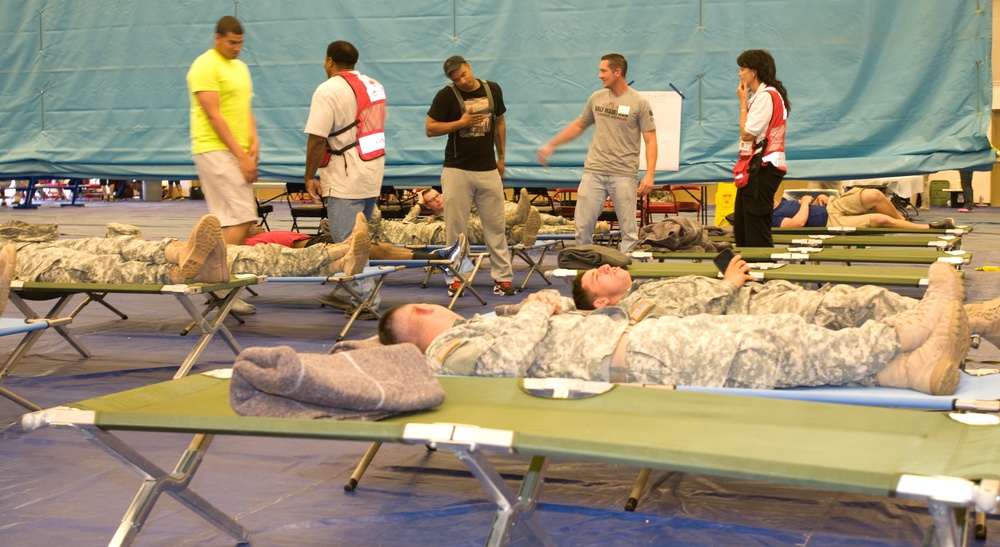
American Red Cross and other volunteers practice shelter support with role-players during the Iron Response exercise at Fort Bliss, Texas, September 4, 2014. Illustrative file photo. U.S. Army photo by Sgt. Jarred Woods. Source: DVIDS (public domain).
That doesn't mean I think the Red Cross is getting everything right. Responding to incidents is what I see the organization do well. The leadership and support behind that response are where I get frustrated, and in my experience they are falling short. I've sat through training where instructors struggled with the camera or the technology they were supposed to be teaching through, and where too much of the instruction amounted to being told to read the book. I teach for a living. Reading the material is part of learning, but it doesn't excuse poorly delivered instruction. If someone has given up time from work or family to train for a disaster response, we owe them instructors who can operate the tools, explain the work, and help them practice it. Corporate leadership needs to take responsibility for making that happen consistently. Those are problems I've encountered as a volunteer, and they are worth fixing before we need those same people to perform on somebody's worst day.
The amount of work volunteers carry is enormous. In fiscal year 2025, the Red Cross reported more than 10.3 million volunteer hours across the organization, and nearly 63,000 volunteers helped communities prepare for and respond to disasters. Those figures come from its Volunteer Services report. They give some scale to the commitment I see from people who keep showing up. I work with retirees who give a tremendous amount of their time to this mission, and God bless the people willing to do that. I also want younger people to have a reason to join and stay. If we're asking somebody to fit this around a job, a family, and bills, we need to respect their time and give them useful training and support. I don't think the organization can keep leaning on people's willingness to give more without looking hard at what it gives them in return. I want leadership to make it easier for good volunteers to do the work, and I want the training to prepare them for the situations they're actually going to face.
That concern about practical preparation is also why I paid attention to CISA's September 18 report on Cyber Storm X. The Cybersecurity and Infrastructure Security Agency brought together 2,000 participants from more than 200 public and private organizations for a four-day exercise involving a simulated nation-state attack on transportation and water systems. They were testing response plans, information sharing, and coordination, and CISA said it would work with participants on lessons learned for a public after-action report. We talk about infrastructure and disaster preparedness with friends, family, and people we work with, but I want to know how much of that discussion has made it into a plan that somebody can actually use. I'm glad they're running the exercise, and I want to see what they learned from it. At my level, I can help get the right people into a conversation about what the Red Cross does and how it supports families after a disaster. That is something I can work on while the larger organizations work through theirs.
Keeping Up With the People We Meet
We're still working with Mission Earned on the consulting and technology side. Some of the work we do in that part of the business is volunteered because we want to give back, and this is a team I'm glad to support. I served with members of the leadership, I know the people involved, and they're doing good work for veterans. If you want to help, take a look at their volunteer opportunities or support their work. We'll also be at Late Skate at the Anacostia Park Roller Skating Pavilion this Saturday, September 26, with our EPS table there from 1:30 to 3:30 p.m. Eastern, doing what we always try to do at these events: giving people information they can use to get training, find work, and move forward. September 21 through 25 is VA Veteran Buddy Check Week as well, so get in touch with somebody you served with and see how they're doing.
We're also putting together a free educational book library for EPS, organized so students can find material relevant to what they're learning. There is still work to do on the library and checking which materials we can share, so I'll have more to say when it is ready. In the meantime, a free shout-out to Readrrr on iOS, which I've been using to read material aloud. I'm about halfway through Meditations again, and I'm getting even more out of it than I did the first time. The app has made it easier to keep going through books and things on my screen when I would otherwise take much longer to get through them. They're not sponsoring me, although they should consider it. So far it has worked well for me, and I hope they keep doing good work.
The part I need to get better at is keeping up with everybody after the event or the first conversation. I get hundreds of emails, a student's message gets pushed down, and then I find it later and realize I never answered them. I don't like that, and I'm working on a better system for tracking those messages and the next step I promised. I followed up with Jamie Hudson on the Fairfax County Department of Family Services Employer Engagement Team after we first spoke in August, and it took longer than it should have. She gave me a lot of useful information about helping their candidates and what it takes to become an approved training provider, and I told her I would follow up with more information from our side. She's a great resource, and I appreciate the time she took. I want to work with more organizations, keep building the training, and help more people, but I only have so much time in a day. Making sure the people who already reached out don't get lost in my inbox is part of getting that right. Memento mori.
References
This assessment incorporates WRDW/WAGT reporting on Amentum's planned reduction of 77 intelligence-related positions at Fort Gordon (wrdw.com, September 15, 2026), corroborated by the official Georgia layoff notice (tcsg.edu, accessed September 23, 2026); Anna Crockett and Sergio Galeano's “Promise, anxiety, and change: What the Fed is learning about AI's impact on work” (Fed Communities, September 22, 2026); American Red Cross guidance on Disaster Action Team response and assistance (redcross.org); the American Red Cross Volunteer Services FY25 Year in Review (redcross.org, fiscal year 2025, pp. 4–5); CISA's Cyber Storm X exercise recap (cisa.gov, September 18, 2026); and the U.S. Department of Veterans Affairs' Veteran Buddy Checks program information (va.gov, updated August 27, 2026). Course details come from the EPS course listing; the community event is listed by the National Park Service. Personal experiences and judgments are the author's own.
Mahalo for reading. This piece first ran on the EPS Dispatch on Substack: What Did You Actually Learn? Subscribe there to get the next one by email.
About the Author
Kawika Rogers is Managing Partner at Eight Point Solutions LLC, a veteran-led defense consulting and training firm based in Maryland. He served as an Infantry Team Leader in the United States Marine Corps, then directed the Field Training Officer program and served as an Armorer for Triple Canopy at Camp Arifjan and Camp Buehring in support of Operation Inherent Resolve. He has also served in an advisory and operational capacity in Eastern Europe. Rogers holds over 15 instructor certifications in firearms, defensive tactics, and emergency medicine, and studied International Relations and Global Security at American Military University.
Eight Point Solutions LLC
7404 Executive Place, 5th Floor, Suite L-17, Lanham, MD 20706
[email protected] // eightpointsolutions.com
SDVOSB // SAM UEI: EY34ARER2TD9
This article draws on publicly available sources and the author's firsthand experience. It does not contain classified information.
The appearance of U.S. Department of War (DoW) visual information does not imply or constitute DoW endorsement.